Four value types
Serve booleans, strings, numbers, or structured JSON and parse them automatically in the SDK.
Remote configuration
Move operational values out of release binaries so product settings, thresholds, messages, and UI behavior can change safely at runtime.
Available now for boolean, string, number, and JSON values in JavaScript and React apps.
Capabilities
Remote values live alongside flags, which means they inherit projects, environments, targeting, rollouts, and predictable fallback behavior.
Serve booleans, strings, numbers, or structured JSON and parse them automatically in the SDK.
Tune production without changing staging, and keep local development values independent.
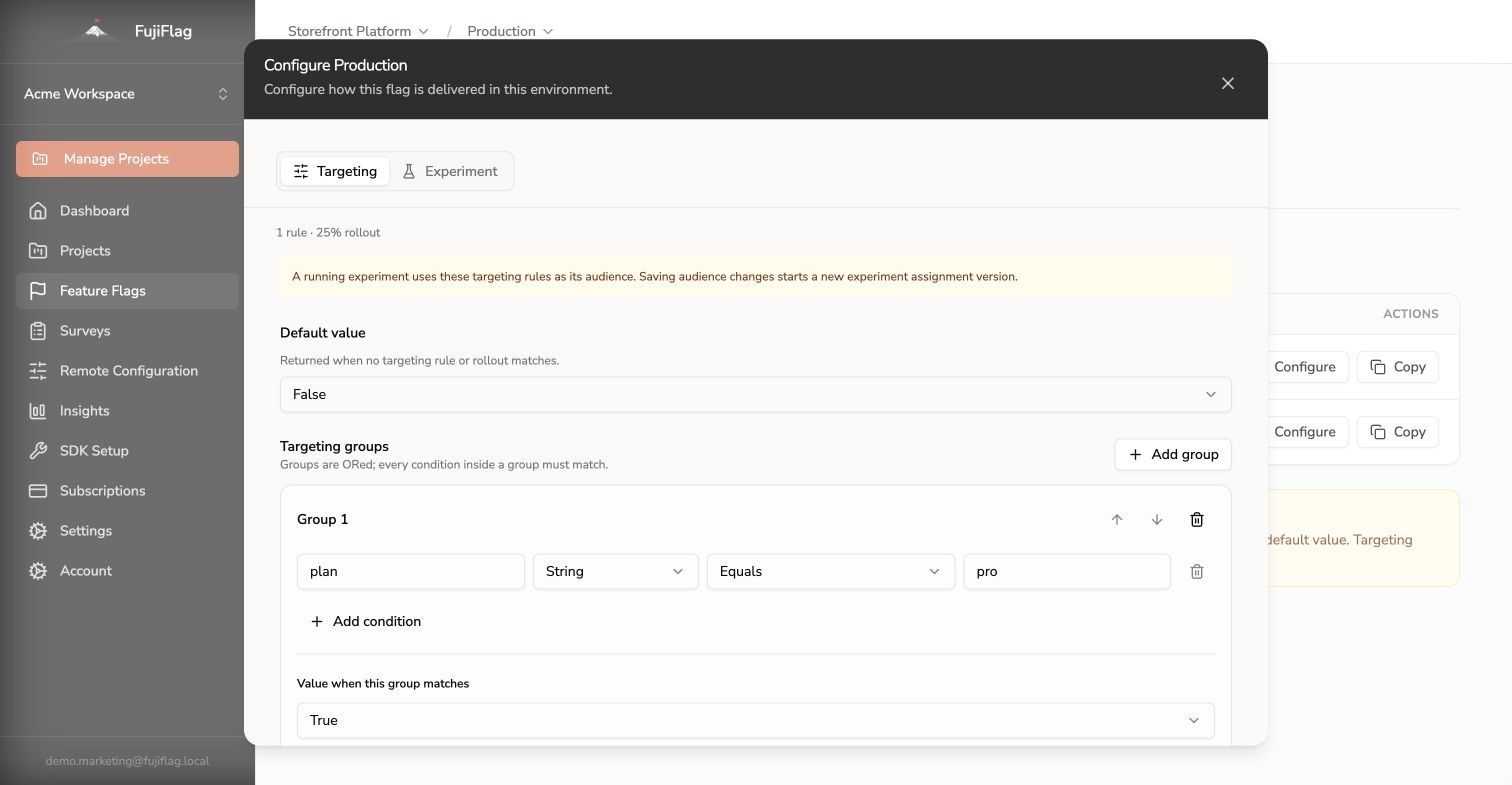
Deliver a value only when context attributes match the rule groups you define.
Introduce a new value to a deterministic percentage of users before making it universal.
Copy full configuration between environments when the same reviewed state should move forward.
Every environment keeps an explicit fallback value for missing context or non-matching rules.
Workflow
Use remote configuration for values that should change faster than your deployment cadence.
Create a key with the type your application expects and a fallback it can always handle.
Fetch one value or the full environment map through the JavaScript or React SDK.
Change the default, add a target rule, or phase in a new value without publishing another build.
Built for implementation
FujiFlag keeps the wire format simple while the SDK parses the configured value into the type your code expects.
type CheckoutConfig = {
  freeShippingAt: number;
  expressEnabled: boolean;
};

const config = await client.getFlagValue<CheckoutConfig>(
  'checkout-limits'
);

if (cart.total >= config.freeShippingAt) {
  applyFreeShipping();
}
One platform
FujiFlag keeps controls, configuration, experiments, and feedback in a shared workspace—without forcing you into a heavyweight suite.
Release control
Separate deployment from release with environment-specific control.
ExploreControlled learning
Compare multiple configuration values with stable subject assignments.
ExploreSDKs
See installation, API patterns, and implementation options for React and JavaScript.
ExploreStart small. Ship safely.
Start with a real operational value—limit, message, theme, or behavior—and move it into a typed FujiFlag configuration.
No credit card required.