Environment values
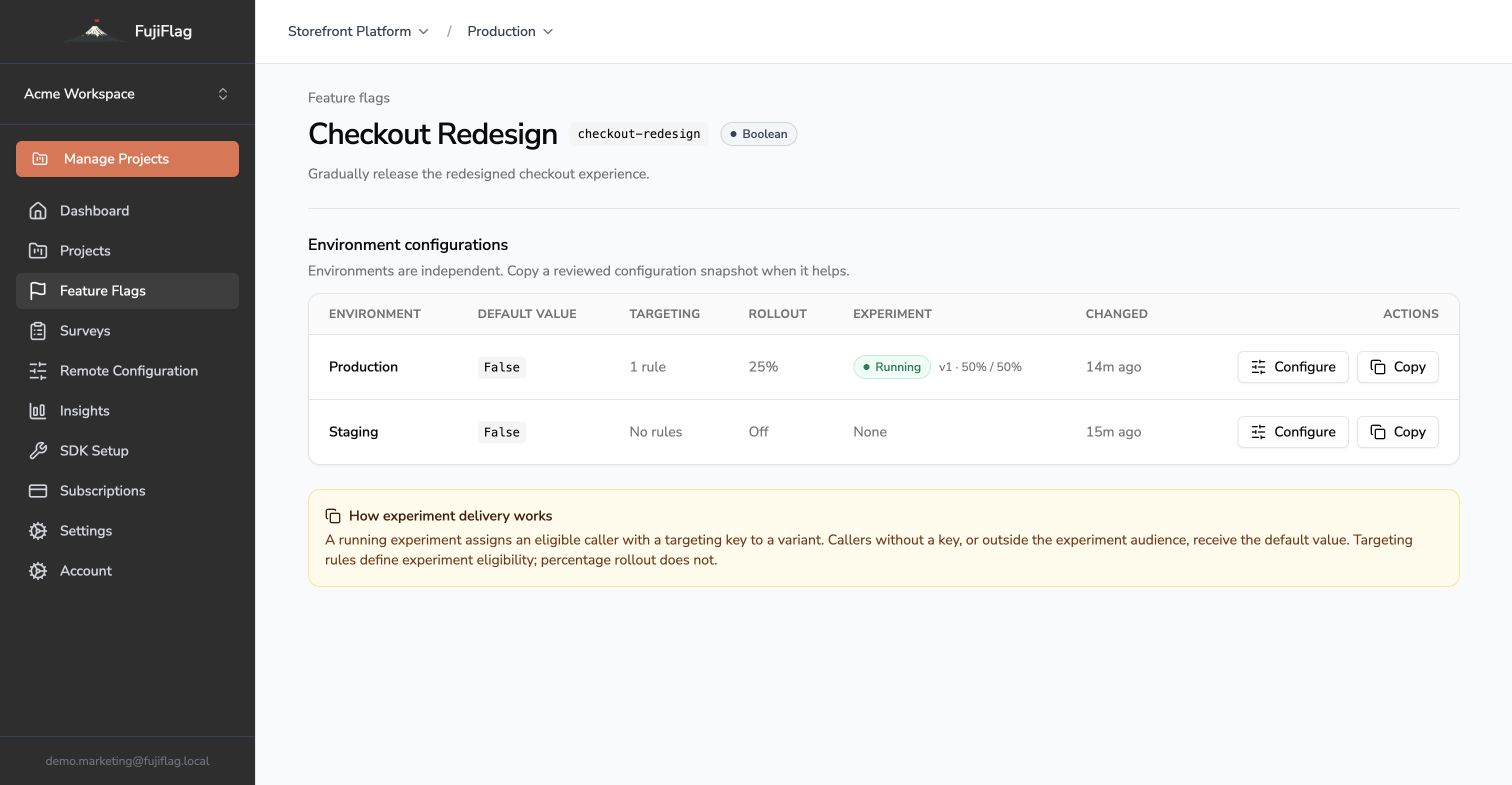
Keep development, staging, and production behavior independent under a single flag key.
Feature flags
Decouple deployment from launch, choose who gets a feature, and increase exposure when the release is ready—not merely when the build is ready.
Available now with boolean, string, number, and JSON flag values.
Capabilities
FujiFlag gives small teams the release controls they usually have to build themselves, with predictable evaluation behavior across environments.
Keep development, staging, and production behavior independent under a single flag key.
Match string, number, and boolean attributes with ordered rules and explicit fallback behavior.
Release to a deterministic percentage of callers using an opaque targeting key and stable hashing.
Use boolean flags or deliver string, number, and JSON values through the same evaluation contract.
Move a reviewed configuration snapshot between environments instead of rebuilding rules manually.
Know whether a value came from a target match, rollout, experiment split, or fallback.
Workflow
A flag becomes a small decision layer between shipped code and visible product behavior.
Choose a stable key, value type, and sensible fallback before the code reaches production.
Target internal users or customer contexts, then add a deterministic rollout when you are ready.
Increase exposure, change the served value, or return to the fallback without another deployment.
Built for implementation
The SDK can return the value alone or the value with the reason and experiment detail that produced it.
import { createFujiFlagClient } from '@fujiflag/js';

const client = createFujiFlagClient({
  apiKey: 'ff-pk-your-key',
});

const enabled = await client.getFlagValue(
  'new-checkout'
);
One platform
FujiFlag keeps controls, configuration, experiments, and feedback in a shared workspace—without forcing you into a heavyweight suite.
Dynamic values
Use the same evaluation model for strings, numbers, and JSON application settings.
ExploreControlled learning
Add stable multi-variant assignment to an eligible flag audience.
ExploreCustomer evidence
Ask eligible users what they experienced while the release is still fresh.
ExploreStart small. Ship safely.
Create a workspace, add an environment, and evaluate your first feature flag with the JavaScript or React SDK.
No credit card required.