Multiple variants
Define a control and one or more alternative values with explicit traffic weights.
Feature experiments
Assign eligible users to stable variants, keep exposure logic next to the flag, and send the decision metadata to the analytics tools your team already uses.
Available now for assignment and exposure metadata. Statistical result analysis remains in your analytics stack.
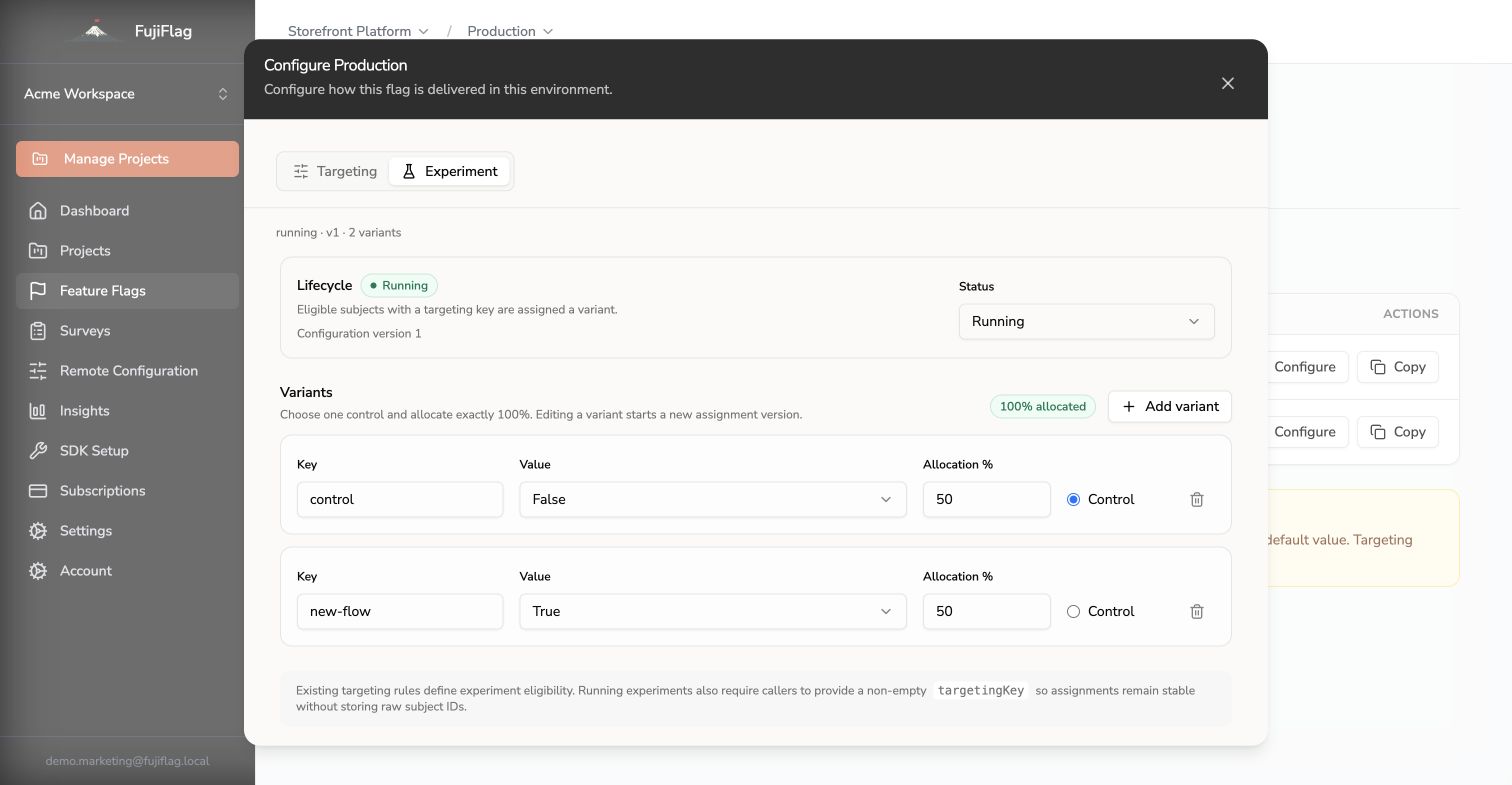
Capabilities
A FujiFlag experiment is an optional allocation layer on an environment-specific flag value—not a disconnected copy of your release configuration.
Define a control and one or more alternative values with explicit traffic weights.
Eligible subjects keep the same variant for an experiment version through deterministic assignment records.
Use the flag's ordered context rules to decide who enters an experiment.
Prepare in draft, run, pause, or end an experiment with a clear operational status.
Read experiment key, variant, version, and evaluation reason for your analytics event.
Material configuration changes create a new assignment version rather than silently reshuffling history.
Workflow
FujiFlag decides the variant. Your analytics stack measures the metric. That boundary keeps the first implementation small and auditable.
Use context targeting—or no rules for all callers—to establish who can enter the experiment.
Choose values and weights, identify the control, and start the experiment when configuration is ready.
Send the returned variant and experiment version with the product event you already measure.
Built for implementation
The React hook and JavaScript client both support detailed evaluation so instrumentation can stay close to the code that renders the experience.
const { value, detail } =
  await client.getFlagEvaluation('pricing-copy');

if (detail.reason === 'SPLIT') {
  analytics.track('experiment_exposure', {
    experiment: detail.experimentKey,
    variant: detail.variant,
    version: detail.experimentVersion,
  });
}
One platform
FujiFlag keeps controls, configuration, experiments, and feedback in a shared workspace—without forcing you into a heavyweight suite.
Eligibility
Create the targeted environment configuration that determines experiment eligibility.
ExploreVariation values
Compare messages, thresholds, and structured behavior—not just on and off.
ExploreQualitative signal
Pair behavioral measurement with direct feedback from the people who used the release.
ExploreStart small. Ship safely.
Add stable variants to a flag, instrument one meaningful metric, and learn without creating a separate delivery path.
No credit card required.